
In today’s rapidly evolving business landscape, the decision between SaaS and traditional software isn’t just a technical choice—it’s a strategic business decision that could make or break your competitive edge. Imagine this scenario: your sales team discovers Salesforce can close deals 30% faster than your legacy CRM, but your CISO demands all customer data stay behind your firewall. This tension between agility and control is playing out in boardrooms across America daily.
$251 billion. That’s the projected global SaaS market size by 2028 according to Grand View Research, signaling a profound shift in how businesses consume technology. Yet nearly 40% of enterprises still rely on mission-critical legacy systems that power everything from manufacturing to healthcare operations.
The truth? There’s no universal “best” solution—only what’s best for your specific business context, risk tolerance, and growth trajectory. As a SaaS specialist with over 15 years of experience guiding US companies through digital transformations, I’ve seen businesses thrive with both models. Let me help you determine which path aligns with your company’s unique needs.
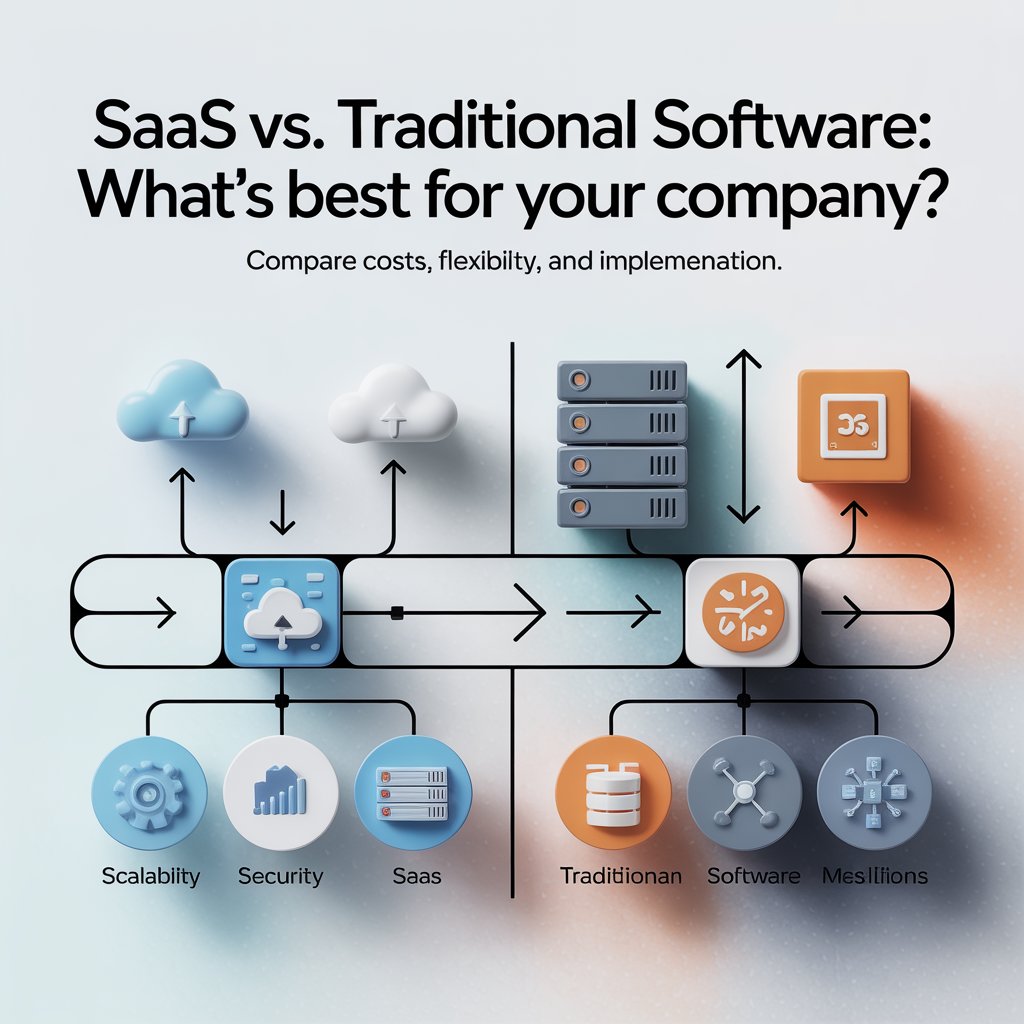
Defining Your Software Battlefield: SaaS vs. Traditional Explained
Software as a Service (SaaS) represents a fundamental shift in software delivery. Instead of purchasing perpetual licenses and installing applications on local servers, SaaS solutions live in the cloud and are accessed via subscription—typically through a web browser. Popular examples include Salesforce for CRM, Microsoft 365 for productivity, and Slack for team communication. The provider maintains all infrastructure, handles security updates, and manages scaling behind the scenes, allowing your team to focus purely on using the software to drive business results.
>
“The brilliance of SaaS isn’t just in the technology—it’s in transforming capital expenditure into operational expenditure, fundamentally changing how businesses allocate resources.” — Jennifer Rodriguez, CIO at a Fortune 500 Financial Services Firm
Traditional software (often called on-premise or legacy software) requires purchasing licenses and installing applications directly on your company’s servers and workstations. This model gives you complete control over the environment but demands significant IT resources for maintenance, updates, and security. Examples include SAP ECC, Oracle E-Business Suite, and custom-built enterprise systems that have powered businesses for decades.
While SaaS adoption continues its meteoric rise, traditional software maintains strong footholds in industries with strict regulatory requirements like healthcare (HIPAA), finance (FINRA), and government contracting (FedRAMP). The critical question isn’t which model is superior, but which better serves your strategic objectives, compliance needs, and organizational capabilities.
Total Cost Analysis: Beyond the Price Tag Confusion
When evaluating software acquisition costs, business leaders often fixate solely on license fees while overlooking the hidden expenses lurking beneath the surface. A true total cost of ownership (TCO) analysis must account for infrastructure, personnel, downtime, and opportunity costs over a 3-5 year horizon.
| Cost Component | SaaS (5-Year Projection) | Traditional Software (5-Year Projection) |
|----------------|--------------------------|------------------------------------------|
| Initial License Fees | $75,000 (subscription) | $150,000 (perpetual license) |
| Infrastructure Costs | $0 (provider-hosted) | $225,000 (servers, cooling, power) |
| IT Staff Time | $60,000 | $300,000 |
| Maintenance & Updates | Included | $180,000 |
| Downtime Costs | $25,000 | $120,000 |
| **TOTAL** | **$260,000** | **$975,000** |
This cost disparity explains why SaaS adoption has surged among SMBs according to Kanhasoft. But don’t be misled—larger enterprises often achieve better economies of scale with traditional deployments when they already maintain robust data centers and IT teams.
The real financial differentiator emerges during growth spurts. Adding 50 users to a SaaS platform typically takes minutes with predictable per-user costs. Expanding traditional infrastructure requires hardware procurement cycles, server configuration, and potential downtime—costs that quickly compound during urgent scaling needs. According to a recent Gartner study, enterprises using SaaS solutions experienced 68% faster user onboarding during rapid expansion phases compared to traditional deployments.
💡 Pro Tip: The TCO Calculation Hack
When building your business case, include “opportunity cost” as a quantifiable metric. Calculate revenue lost from delayed feature rollouts common with traditional software’s 12-18 month upgrade cycles versus SaaS’s continuous delivery model. For a $10M ARR business, even a conservative 2% revenue impact from delayed feature deployment totals $200,000 annually—making SaaS potentially more cost-effective even with higher subscription fees.
Security Showdown: Myths vs. Reality
Few topics generate more anxiety than software security, with persistent myths clouding decision-making. Many executives assume “my data is safer behind my firewall,” but cloud providers often implement security protocols exceeding what 95% of enterprises could justify building internally.
Enterprise-grade SaaS providers typically invest 15-20% of their revenue into security infrastructure—far exceeding the industry average of 6-8% for enterprise IT departments. They employ dedicated security teams monitoring threats 24/7/365 and benefit from economies of scale that allow them to implement cutting-edge protections like AI-powered anomaly detection and automated threat response systems.
| Security Aspect | SaaS Advantage | Traditional Software Advantage |
|-----------------|----------------|--------------------------------|
| Physical Security | ✅ Enterprise data centers with biometric access, 24/7 guards, disaster recovery | ❌ Requires significant investment in secure facilities |
| Patch Management | ✅ Immediate, automatic security patches across all customers | ❌ Manual patching creates vulnerability windows |
| Compliance Certifications | ✅ Often maintain multiple certifications (SOC 2, HIPAA, GDPR) | ❌ Certification burden falls entirely on your organization |
| Data Residency Control | ❌ Limited control over physical data location | ✅ Full control over server locations |
>
“Modern SaaS platforms like Salesforce and ServiceNow actually exceed federal security requirements for many industries—the notion that cloud equals less secure is dangerously outdated,” states Michael Chen, cybersecurity expert cited in Nexiby’s security analysis.
The critical factor isn’t deployment model but your organization’s security maturity. Companies with sophisticated security operations centers and strict data sovereignty requirements may favor traditional deployments. However, for most businesses—particularly those lacking dedicated security teams—enterprise SaaS providers deliver superior protection through specialized expertise and continuous monitoring capabilities small teams simply cannot replicate.
Scalability and Business Agility: The Growth Imperative
In today’s volatile market, your software’s ability to scale with business fluctuations isn’t just convenient—it’s existential. The pandemic taught us that businesses must pivot rapidly, and your technology stack determines whether you surf the wave or get crushed by it.
SaaS solutions shine in dynamic environments through their inherent elasticity. Need to onboard 200 remote salespeople overnight? Done. Facing unexpected demand requiring immediate capacity expansion? Scaled automatically. Traditional software often requires months of procurement cycles and manual configuration to accommodate such changes—a luxury few businesses can afford in today’s hyper-competitive markets.
Real-World Impact: The Pandemic Pivot
When lockdowns hit in March 2020, companies using SaaS productivity suites like Microsoft 365 expanded remote access capabilities in hours. Those relying on traditional VDI solutions faced weeks of delays as IT teams scrambled to procure additional server capacity. This agility difference directly impacted revenue continuity, with SaaS-using organizations maintaining 92% productivity versus 68% for traditional software users according to [UIUX Minimal’s 2026 analysis](https://www.uiuxminimal.com/blog/saas-vs-traditional-software/).
The hidden agility killer in traditional deployments isn’t just scaling up—it’s scaling down. Economic uncertainty requires businesses to rightsize operations quickly. With SaaS, you adjust subscriptions monthly. With traditional software, you’re stuck with underutilized servers and licenses whether you need them or not. This operational flexibility proves invaluable during economic volatility, allowing businesses to match technology costs directly to current needs rather than forecasting guesses made years earlier.
Pro Tip: Calculate your business’s “agility premium”—the revenue impact of delayed responses to market changes. If a one-month delay in launching new features costs more than your annual SaaS premium, the cloud model likely delivers superior ROI regardless of initial price comparisons.
Customization Dilemma: Flexibility vs. Control
The customization debate represents perhaps the most nuanced aspect of the SaaS versus traditional discussion. Legacy system advocates often cite customization capabilities as their primary rationale, while SaaS proponents argue standardization drives efficiency. Both perspectives contain truth—but require context.
Traditional software deployments offer near-limitless customization potential through direct database access, middleware integration, and deep code modifications. Pharmaceutical giants like Pfizer maintain highly customized SAP instances supporting unique regulatory workflows that would be impossible with out-of-the-box solutions. However, this flexibility comes at significant cost—each customization becomes technical debt requiring maintenance during every upgrade cycle.
SaaS platforms historically faced customization limitations, but modern solutions have bridged much of this gap through:
- Robust API ecosystems (Salesforce’s 5,000+ AppExchange integrations)
- Low-code configuration tools (Microsoft Power Platform)
- Containerized extensions (ServiceNow’s Flow Designer)
- Domain-specific scripting capabilities (Zendesk’s Sunshine platform)
>
“Today’s enterprise SaaS platforms offer 80% of traditional customization capabilities with 20% of the maintenance burden—a tradeoff most businesses should welcome,” advises Clara Martinez, VP of Technology at a major retail chain per CC Creative’s analysis.
The optimal approach often involves strategic standardization—adopting SaaS for standardized processes (HR, CRM, collaboration) while maintaining traditional deployments for truly unique differentiators. This hybrid model powers industry leaders like Nike, which uses ServiceNow for IT service management while maintaining custom legacy systems for proprietary manufacturing processes.
When to Choose Which: Decision Framework
After analyzing hundreds of enterprise deployments, I’ve developed this battle-tested framework to determine the optimal path for your organization:
Choose SaaS when:
- Your primary business processes align with industry best practices
- Rapid scalability (up or down) is critical to your business model
- Limited internal IT resources handle infrastructure management
- Predictable operational expenditure fits your financial planning
- Remote or hybrid work is permanent for significant portions of staff
Choose Traditional Software when:
- Unique regulatory requirements mandate specific data handling
- Your core competitive advantage resides in highly customized workflows
- Existing infrastructure investments provide significant economies of scale
- Internet connectivity limitations impact operational continuity
- Long-term TCO favors capital expenditure over operational expenditure
| Decision Factor | SaaS Recommended | Traditional Recommended |
|----------------|------------------|--------------------------|
| Company Size | Startups, SMBs | Large enterprises with mature IT |
| Industry Regulation | Moderate compliance needs | Highly regulated (e.g., defense, nuclear) |
| Technical Staff | Limited internal IT | Large, specialized IT department |
| Growth Stage | Rapid scaling phase | Stable, predictable operations |
| Strategic Priority | Speed to market | Maximum control & customization |
Future-Proofing Your Decision: 2026 Considerations
The software landscape continues evolving rapidly, with several trends reshaping the SaaS versus traditional calculus in 2026:
The Hybrid Acceleration: The strict dichotomy between SaaS and traditional is fading as hybrid models dominate. Modern enterprise architecture increasingly features SaaS front-ends connected to traditional back-ends via secure APIs—a pattern TechAhead documents in their analysis of enterprise switching patterns.
AI-Driven Automation: Next-generation SaaS platforms now embed AI capabilities that traditional systems struggle to match. Salesforce Einstein and Microsoft 365 Copilot demonstrate how cloud-native architectures enable real-time AI processing impossible with legacy batch-oriented systems.
Edge Computing Integration: As IoT expands, both models are adapting. SaaS providers now offer edge capabilities (AWS Greengrass, Azure IoT Edge), while traditional vendors develop cloud-connected architectures. The distinction now rests less on location than on management model.
Your Action Plan: Making the Right Choice
The most successful organizations I’ve worked with follow this proven methodology:
- Map critical workflows: Identify which processes directly impact competitive differentiation versus those following industry standards
- Quantify agility requirements: Calculate the revenue impact of delayed feature deployment using historical data
- Stress-test scenarios: Model responses to hypothetical events (sudden 200% user growth, regulatory changes, market downturns)
- Evaluate hybrid possibilities: Explore where integration between models might deliver optimal results
- Negotiate strategically: SaaS contracts now offer unprecedented flexibility—leverage competition for customized terms
$1.2 trillion. That’s the estimated wasted expenditure over five years from poor software decisions according to Forrester Research. Your careful evaluation today prevents costly reactive changes tomorrow.
Don’t let analysis paralysis stall your progress. Identify one department where you can pilot both approaches—a controlled experiment comparing results over 6-12 months delivers more valuable insights than theoretical debates. Document your findings rigorously, then scale what works across your organization.
The Final Verdict: It’s Your Business Strategy, Not Technology
The SaaS versus traditional software debate ultimately isn’t about technology—it’s about business strategy. Your choice should flow from answers to these fundamental questions:
- How quickly must we adapt to market changes?
- What differentiates us competitively?
- Where should we allocate scarce technical resources?
- What keeps our leadership awake at night?
For most American businesses in 2026, SaaS delivers compelling advantages in agility, cost predictability, and security—particularly for standardized business functions. However, traditional deployments remain vital where deep customization, regulatory constraints, or massive existing infrastructure investments create unique requirements.
The most successful organizations I consult with today aren’t choosing between SaaS and traditional—they’re strategically deploying both where each delivers maximum value. This nuanced approach, grounded in business requirements rather than technological dogma, represents the true path to digital maturity.
Ready to make your move? Start with a 90-day assessment of your three most critical applications. Quantify current pain points, project growth requirements, and calculate the true cost of inertia. The answer will become clear—and your competitors will wonder how you transformed operations while they remained paralyzed by indecision.