
Acquiring a new SaaS customer can cost five to twenty-five times more than keeping an existing one — yet most growth teams still pour budget into top-of-funnel while the leaky bucket quietly drains ARR. The math is unforgiving: if your customer churn rate sits at 5% monthly, you’re replacing more than half your base every year just to stay flat. Flip the script and push net revenue retention (NRR) from 85% to 115%, and you can roughly double your growth without signing a single new logo.
This guide walks you through a repeatable SaaS customer retention strategy built on real cohort data, product-led engagement, and proactive customer success. You’ll get a step-by-step playbook to reduce churn, increase customer lifetime value (LTV), and turn renewals into expansion opportunities. Industry benchmarks put best-in-class SaaS NRR above 120% for enterprise and around 100% for SMB — and the tactics below are what separate those leaders from the rest.
Let’s get started.
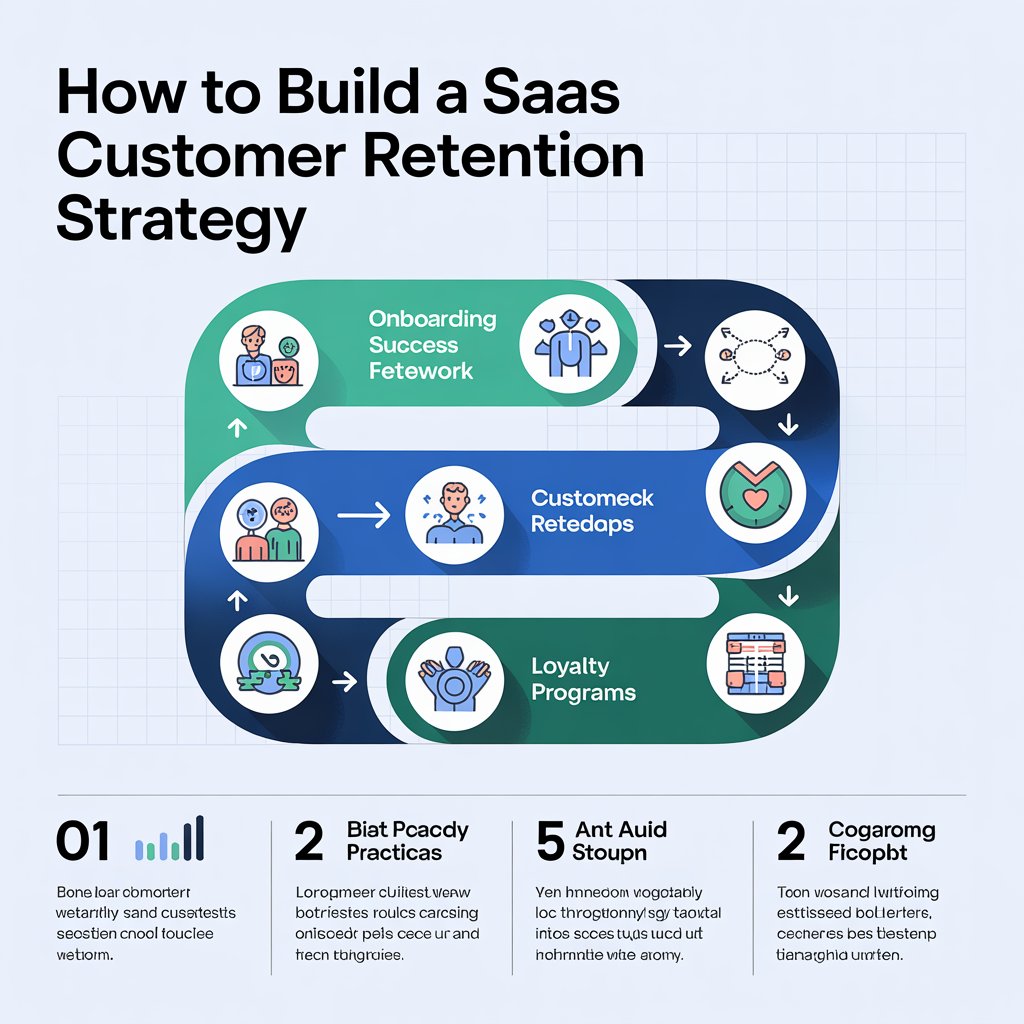
Why Retention Matters for SaaS
SaaS unit economics live or die on the relationship between customer acquisition cost (CAC) and lifetime value (LTV). Most companies need 12–18 months of subscription revenue just to recover CAC; any customer who leaves before that payback period destroys margin. That’s why a healthy lifetime value to customer acquisition cost (LTV:CAC) ratio — typically 3:1 or higher — is impossible without strong subscription retention tactics.
Retention also compounds. A cohort that stays for 36 months instead of 18 generates roughly 2× the revenue without a single extra dollar of marketing spend. Higher retention means lower acquisition pressure, more predictable revenue for forecasting, and a growing base of advocates who drive referral-led pipeline. Expansion revenue from upsell and cross-sell compounds the flywheel further: Bain’s long-cited research suggests a 5% increase in retention can lift profits by 25% to 95%, depending on the business.
The biggest misconception in SaaS is the belief that growth-through-acquisition can outrun churn. It almost never does at scale. Once you pass $5M–$10M ARR, the sheer volume of renewals you need to replace every quarter becomes operationally impossible to fill with new logos alone. Retention isn’t a support function — it’s the single highest-leverage growth lever you have.
Build the Framework: Key Components of a Retention Strategy
A defensible retention strategy isn’t a single initiative; it’s a system of interconnected levers. Build yours across six pillars.
- Ideal Customer Profile (ICP) and onboarding fit. Retention starts before the contract is signed. Customers who don’t match your ICP churn disproportionately — usually within 90 days. Tighten qualification criteria and track early churn by segment to calibrate who sales should pursue.
- Product-led vs. sales-led retention levers. In PLG motions, retention rides on in-product signals: activation rate, habit loops, and self-serve upgrades. In sales-led motions, retention rides on relationships, QBRs, and executive sponsorship. Most modern SaaS companies need both.
- Customer success and account management alignment. CS owns adoption and health; AM owns commercials. Misalignment here is the #1 cause of enterprise churn. Define handoffs, shared dashboards, and a unified customer health score so both teams act on the same signal.
- UX and feature adoption. The silent killer of retention is the gap between what your product can do and what customers actually use. Instrument behavioral analytics for SaaS to see where users drop off, then invest in feature discoverability, tooltips, and workflow shortcuts.
- Pricing, packaging, and contractual controls. Annual contracts reduce measured churn but don’t fix underlying dissatisfaction. Use value-based packaging, usage tiers, and multi-year incentives that reward commitment without masking product problems.
- Data and analytics foundation. None of this works without cohort analysis and retention curves as the source of truth. Segment by ICP, ARR band, plan, and acquisition channel. If you can’t see retention by cohort, you can’t improve it.
Mini case: A B2B analytics SaaS at $6M ARR discovered through retention cohort analysis that customers who didn’t connect a second data source within 14 days had 4× the six-month churn rate. They rebuilt onboarding around that single activation milestone and lifted 12-month NRR from 94% to 108% in two quarters — without changing the core product.
Practical Step-by-Step Playbook
Here are eight sequential steps to operationalize the framework.
Step 1: Map the Customer Lifecycle and Identify Churn Moments
Draw the journey from signup → activation → first value → habit → expansion → renewal. Layer in your retention funnel analytics to spot drop-offs. Run five qualitative interviews with recently churned customers — you’ll hear patterns no dashboard reveals.
Step 2: Set Retention Goals and KPIs
Pick a primary metric (usually logo churn or NRR) and segment it. A realistic starting target is 1–2% monthly logo churn for SMB and 90%+ gross revenue retention (GRR) for enterprise. Track expansion MRR separately so upsell doesn’t mask underlying churn.
Step 3: Improve Onboarding and Time-to-Value (TTV)
Onboarding best practices converge on one idea: get customers to their first “aha” moment as fast as possible. Use personalized onboarding checklists, milestone emails, and in-product guides. Build trigger-based flows — for example, if a user hasn’t hit the activation event by day 3, send an in-app prompt; if not by day 7, escalate to a CSM.
Step 4: Increase Product Engagement and Habit Formation
Product-led growth retention depends on core loops. Identify the behavior that correlates with long-term retention (e.g., “sends 3 reports per week”) and instrument user engagement metrics around it. Use behavioral prompts, empty states that teach, and light gamification to reinforce the loop.
Step 5: Build Proactive Customer Success and Health Scoring
Construct a customer health score from four signals: product usage trend, NPS/CSAT, open support tickets, and payment behavior. Weight them by predictive power (run a logistic regression on historical churn if you can). Define a customer success playbook for each health tier — red accounts get an executive call within 48 hours, yellow get a CSM review, green get an expansion motion.
Step 6: Drive Expansion Through Value Realization
Expansion revenue is the highest-margin growth you’ll ever see. Trigger upsell and cross-sell plays when customers hit usage ceilings, hire new users, or enter new business units. Arm CSMs with ROI reports that quantify value before the commercial conversation.
Step 7: Reduce Friction at Renewal and Cancellation
Start the renewal conversation 90 days out, not 30. Offer grace periods, down-sell paths, and pause options before accepting cancellation. Run a win-back strategy sequence for 90 days post-churn — 10–20% of churned customers return if the original friction is resolved. Use exit surveys ruthlessly and route themes to product.
Step 8: Use Feedback Loops for Continuous Improvement
Close the loop on every NPS detractor, every support ticket tagged “confusing UX,” and every feature request. Feed themes into roadmap prioritization quarterly. Retention is a product problem as much as a CS problem — teams that treat it as only the latter plateau quickly.
Measuring Success and Reporting
Build a retention metrics dashboard around six core indicators:
| Metric | What It Measures | Target Benchmark |
|---|---|---|
| Gross Revenue Retention (GRR) | Revenue retained, excluding expansion | ≥85% SMB, ≥90% enterprise |
| Net Revenue Retention (NRR) | Adds expansion on top of GRR | ≥110% best-in-class |
| Logo churn (monthly/annual) | Customers lost, segmented by cohort | ≤2% monthly SMB |
| LTV & LTV:CAC | Value generated vs. cost to acquire | ≥3:1 |
| Retention cohort curves | Month-over-month retention by segment | Flattening above 80% by month 12 |
| Expansion MRR | Upsell + cross-sell − contraction | ≥10% of starting MRR annually |
Review cadence matters. Run weekly health-score alerts, monthly cohort reviews with product and marketing, and quarterly retention retrospectives with execs. For every intervention — a new onboarding flow, a CSM playbook change, a pricing test — run a clean A/B test and measure causal impact on retention at day 30, 60, and 90. Most teams skip this step and end up confusing correlation with causation.
🚨 Common Pitfalls (and How to Avoid Them) — click to expand
- Reactive support over proactive success. Waiting for a ticket before engaging an at-risk account is always too late.
- Vanity metrics over cohorts. Blended churn hides rot in specific segments. Drill into retention cohort analysis every month.
- Treating SMB and enterprise the same. They churn for different reasons and need different playbooks, pricing, and CS ratios.
- Discounting instead of fixing. A 20% renewal discount patches the quarter and poisons the next one. Fix the underlying value gap.
- Ignoring product. CS cannot compensate for a product that doesn’t deliver value. Fund the roadmap accordingly.
✅ Quick Checklist & Tactical Tool Stack — click to expand
Immediate actions (do this month):
- Map your customer lifecycle and retention funnel end-to-end.
- Build a weighted customer health score and alert on red accounts.
- Redesign onboarding around one clear activation milestone.
- Instrument cohort analysis by ICP, channel, and plan tier.
- Launch one retention experiment this quarter with a defined hypothesis.
Tool stack worth considering:
- Product analytics: Mixpanel, Amplitude, Heap, GA4
- CRM / customer success: Gainsight, HubSpot, Catalyst, Vitally
- In-app messaging: Intercom, Customer.io, Appcues, Pendo
- Surveys and NPS: Delighted, Typeform, Wootric
- Billing and subscription: Stripe, Chargebee, Recurly — critical for renewal rate automation and dunning
Prioritize tools that unify behavioral data and CS signals; siloed tools create siloed teams.
Conclusion: Your Next Steps
Retention is not a support initiative — it’s the highest-leverage growth system in SaaS. When you anchor strategy in cohort data, product-led engagement, and proactive customer success, reduced churn and higher NRR become predictable, not lucky.
Your next step: run an onboarding audit this week, instrument one health-score signal, and launch a single measurable retention experiment this month. Small, compounding wins beat heroics every time.