
A New Era of Work Is Already Here
Not long ago, the idea of running a global team from a laptop in Bali—or managing a product launch without a single in-person meeting—sounded far-fetched. Today, it’s Tuesday.
By 2026, an estimated 32% of the global workforce works remotely at least part of the time, according to Gartner’s Future of Work report. And behind nearly every thriving remote team is a stack of Software-as-a-Service tools quietly holding things together. The project manager in Toronto syncing with the designer in Lagos. The sales team in Singapore closing deals while their counterparts in London sleep. None of it would function without the invisible infrastructure of cloud-based productivity software.
But SaaS isn’t just changing how we work—it’s changing what work means. Concepts like “office culture,” “water cooler conversation,” and even “working hours” are being redefined in real time. The rise of asynchronous communication tools, AI-powered workflows, and integrated collaboration platforms has made distributed work not just possible, but in many cases preferable.
This post explores exactly how SaaS is changing remote work culture—from the platforms that power daily operations to the emerging technologies reshaping the future of distributed workforces. Whether you’re an HR professional building a remote-first people strategy, a digital nomad hunting for the best tools, or a SaaS enthusiast tracking industry shifts, this guide is for you.
The core thesis: SaaS isn’t merely software you subscribe to. It’s the cultural scaffolding of modern work—shaping collaboration norms, productivity expectations, team relationships, and even how people think about work-life balance in hybrid work models.
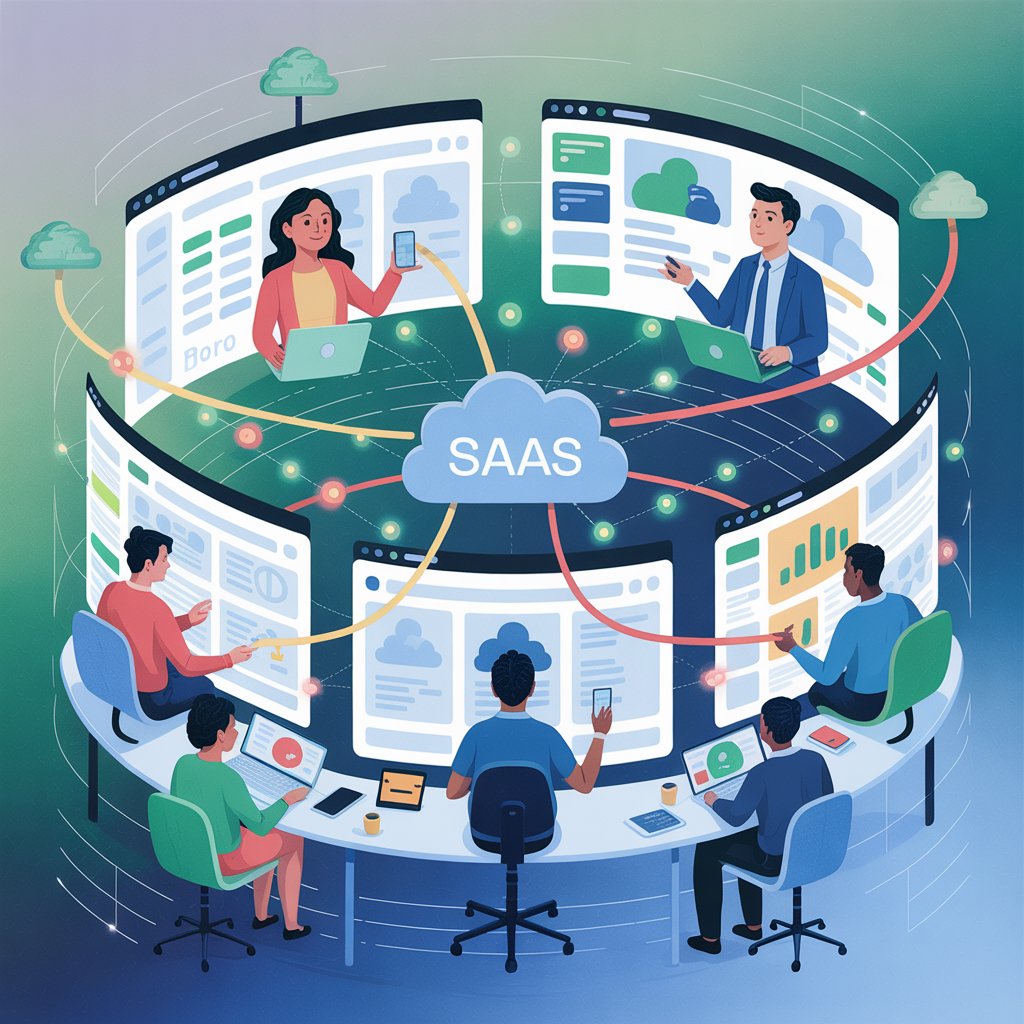
The Rise of Remote Work and SaaS as the Backbone
To understand how SaaS is changing remote work culture, you first have to understand how dramatically work itself has shifted.
The pre-2020 default was office-centric. Collaboration meant physical proximity. “Productivity” was measured partly by visibility—who was seen at their desk, who stayed late. Remote work existed on the margins, tolerated for a few roles but rarely celebrated.
Then the pandemic forced a global experiment. Organizations that had resisted remote work for years found themselves operating fully distributed overnight. The ones that survived—and thrived—were those that had already embraced cloud-based productivity software.
Slack became the de facto office hallway. Zoom replaced the conference room. Notion turned into the shared brain for teams that could no longer gather around a whiteboard. These weren’t just tools. They were the new cultural infrastructure of work.
What made SaaS the natural backbone of this shift? Three things: accessibility, scalability, and speed. Unlike legacy on-premise software, SaaS platforms required no hardware, no IT department to configure servers, and no lengthy rollout. A team could go from zero to fully operational on Google Workspace in an afternoon. That agility was precisely what the distributed workforce moment demanded.
Today, the average knowledge worker uses 9.4 SaaS applications per day, according to Okta’s Businesses at Work report. Remote teams often use more. The SaaS ecosystem didn’t just support the remote work transition—it made it irreversible.
Top SaaS Remote Work Tools Revolutionizing Daily Operations
When people talk about remote work tools, they often mention the same handful of names. But the reality is richer and more nuanced. Here’s a look at the platforms actively reshaping how distributed teams operate:
| Tool | Category | Key Remote Feature | Best For |
|---|---|---|---|
| Slack | Async Communication | Channels, Huddles, Clips | Team messaging & culture |
| Asana | Project Management | Timeline, Workload views | Virtual team management |
| Notion | Knowledge Base | Collaborative wikis, databases | Documentation & async work |
| Google Workspace | Productivity Suite | Real-time co-editing, Drive | Document collaboration |
| Zoom | Video Conferencing | Breakout rooms, AI companion | Synchronous meetings |
| Loom | Video Messaging | Async video walkthroughs | Reducing meeting load |
| Miro | Visual Collaboration | Infinite canvas, templates | Brainstorming & workshops |
What this table doesn’t capture is the cultural weight each tool carries. Asana, for instance, has become synonymous with accountability in distributed teams—if it’s not in Asana, it doesn’t exist. Loom has quietly dismantled the “quick meeting” as a default, giving teams a way to communicate complex ideas asynchronously without scheduling fatigue.
The rise of asynchronous communication tools like Loom and Notion represents a deeper cultural shift: the move away from real-time availability as the measure of engagement. In a truly distributed team, the best work often happens at 2 PM in one city and 11 PM in another. SaaS tools that respect time zones aren’t just features—they’re values embedded in software.
For virtual team management, platforms like Asana and Monday.com have also introduced a new accountability norm. Tasks are visible, deadlines are tracked, and progress is measured without micromanagement. This transparency has changed the manager-employee relationship in fundamental ways—shifting authority from presence to output.
Boosting Productivity and Efficiency in Virtual Environments
One of the most significant ways SaaS is changing remote work culture is through the integration of AI and analytics into everyday workflows.
SaaS analytics for performance tracking have matured enormously. Tools like Workday, Lattice, and even Slack’s own analytics dashboards give managers insight into team health, workload distribution, and collaboration patterns—without resorting to surveillance software. This shift from monitoring to insight is culturally meaningful: it signals that the goal is productivity, not oversight.
AI-powered SaaS for remote teams is perhaps the fastest-moving frontier. Consider a few examples from 2025–2026:
- Grammarly Business doesn’t just fix grammar—it flags tone inconsistencies in team communications, helping distributed teams maintain professionalism across cultures and languages.
- Otter.ai transcribes and summarizes meetings in real time, meaning team members in different time zones can review key decisions without attending every call.
- Notion AI synthesizes long documents and meeting notes into action items, cutting hours of administrative overhead per week.
- GitHub Copilot has reduced engineering onboarding time at fully remote companies by automating repetitive code tasks, accelerating how quickly new developers become productive.
A 2025 McKinsey report found that remote teams using AI-integrated SaaS tools reported 23% higher output than those using traditional software stacks. The productivity gains aren’t hypothetical—they’re measurable and compounding.
The cultural implication? Expectations are rising. Remote workers equipped with these tools are expected to produce more, faster, and with less friction. The flip side is that SaaS is also removing many of the manual, low-value tasks that used to fill the workday—freeing people to focus on work that actually requires human judgment.
Fostering Collaboration in Hybrid Work Models
Perhaps nowhere is the tension of modern work more visible than in hybrid environments—where some employees are in-office, some are fully remote, and the rules of engagement are still being written.
SaaS collaboration platforms have become the equalizers. When half a team is in a conference room and the other half is dialing in from home, tools like Microsoft Teams or Miro can create an experience where everyone participates on equal footing—provided the organization actually commits to using them that way.
The challenge is real: Buffer’s 2026 State of Remote Work survey found that one of the top frustrations for remote employees in hybrid settings is feeling excluded from informal decision-making that happens in physical spaces. SaaS tools can mitigate this, but only if the culture backs them up.
Miro’s virtual whiteboard, for example, enables genuine co-creation across time zones—not just passive viewing of what someone else designed. Microsoft Teams’ “Together Mode” reduces the psychological distance of video calls by placing participants in a shared virtual environment.
The time zone challenge deserves special mention. A distributed team spanning New York, London, and Singapore has roughly a two-hour overlap window. Asynchronous communication tools—combined with strong documentation habits powered by Notion or Confluence—allow teams to maintain momentum without everyone being awake at the same time.
The organizations succeeding in hybrid work models share one trait: they treat async-first as a default, not an exception. SaaS makes that culture possible; leadership makes it real.
SaaS-Driven Work-Life Balance and the Digital Nomad Lifestyle
The digital nomad lifestyle has gone mainstream. By 2026, an estimated 35 million people globally identify as digital nomads, according to MBO Partners. For this growing cohort, SaaS isn’t just a work tool—it’s a life infrastructure.
But SaaS is doing something more subtle than enabling location independence. It’s also reshaping work-life boundaries for everyone, not just nomads.
SaaS-driven work-life balance has become a design philosophy. Tools like Toggl Track help remote workers log and audit their actual working hours—often revealing the “always-on” creep that kills sustainable remote work. Calendly removes the friction of scheduling without requiring people to expose their entire availability. Reclaim.ai uses AI to automatically protect time blocks for deep work and personal commitments.
On the wellness side, platforms like Calm for Business and Modern Health have been integrated into employee benefit stacks at companies like Airbnb and Shopify, offering remote workers mental health support without requiring a commute to an EAP office.
Remote onboarding processes have also been transformed. What once required a week of in-person sessions, badge photos, and desk assignments can now be fully orchestrated through tools like Workday, Notion wikis, and Loom video libraries. New hires can onboard asynchronously, at their own pace, with access to everything they need from day one. This has meaningfully reduced the cultural anxiety of starting a new job remotely.
Scalability and Security: Building Robust Remote Infrastructure
As remote teams grow, so does the complexity of keeping them connected, compliant, and secure. Scalable remote infrastructure is no longer optional—it’s existential.
Cloud platforms like AWS, Azure, and Google Cloud have made it possible for startups to operate with the infrastructure of enterprises from day one. Salesforce gives distributed sales teams a single source of truth regardless of geography. Tools like Workato and Zapier integrate siloed SaaS apps into coherent workflows, preventing the data fragmentation that haunts growing remote organizations.
Cybersecurity in remote SaaS environments has become one of the most urgent concerns for IT and security teams. With employees accessing sensitive data from home networks, coffee shops, and co-working spaces worldwide, the traditional perimeter-based security model has collapsed.
The response has been the adoption of zero-trust architectures—where no user or device is trusted by default, even inside the corporate network. Tools like Okta (identity management), Cloudflare Access (zero-trust network access), and CrowdStrike (endpoint protection) have become foundational to the remote SaaS stack.
VPN integrations remain standard, but the more sophisticated move is toward continuous authentication and least-privilege access—ensuring that even if credentials are compromised, the blast radius is limited. Companies that get this right build a competitive advantage: they can hire globally without creating unacceptable security risk.
Challenges and Solutions in SaaS-Powered Remote Cultures
Acknowledging that SaaS is changing remote work culture for the better doesn’t mean ignoring the friction points. Here are the most common pitfalls—and how forward-thinking teams are solving them:
- Tool overload and app fatigue: The average remote worker now switches between 11+ SaaS apps per day. Consolidation platforms like Notion (which replaces Confluence, Trello, and parts of Asana for many teams) and integration tools like Zapier reduce cognitive overhead.
- Data silos: When teams use separate tools that don’t talk to each other, institutional knowledge fragments. Solutions include iPaaS platforms (Workato, Boomi) and choosing SaaS tools within integrated ecosystems like Google Workspace or Microsoft 365.
- Communication overload: Always-on messaging culture creates burnout. Establishing async norms—like response-time expectations and “no-meeting Wednesdays”—combined with tools like Clockwise or Reclaim.ai, helps teams reclaim focus time.
- Onboarding inconsistency: Remote onboarding without structure leads to confused, disengaged new hires. Standardized Loom libraries, Notion playbooks, and buddy systems built into tools like BambooHR address this.
- Collaboration inequity in hybrid settings: When remote employees feel like second-class citizens relative to office workers, engagement plummets. Deliberate async-first policies and tools like Miro or Figma—where everyone works in the same digital space—are the antidote.
The Future of Distributed Workforces with Emerging SaaS Trends
Where does this go next? The future of distributed workforces is being shaped by several converging SaaS trends worth watching closely.
AI automation will continue to absorb the routine: scheduling, note-taking, first-draft creation, code review, and data analysis. This will free distributed teams to focus on strategy, creativity, and relationship-building—the things AI still can’t replicate. Expect AI copilots to become standard across every SaaS category within two to three years.
Spatial computing and VR workspaces are moving from novelty to niche adoption. Platforms like Immersed and Meta Horizon Workrooms are still early-stage, but they represent a meaningful attempt to restore the serendipitous, improvisational quality of physical co-working—without the real estate cost. By 2028, it’s plausible that “virtual office hours” in a shared 3D space will be as normal as a Zoom call is today.
Vertical SaaS—software built for specific industries and roles rather than generic teams—will proliferate. Remote-first healthcare teams, law firms, and construction crews will stop trying to adapt horizontal tools and will adopt purpose-built platforms that speak their language.
Finally, composable SaaS architectures—where organizations build custom workflows by combining modular SaaS components via APIs—will become the standard for mature remote organizations. The future isn’t one super-app; it’s a curated, interconnected ecosystem tuned to how each team actually works.
Conclusion: SaaS Isn’t Just Software—It’s the New Culture
The story of how SaaS is changing remote work culture is ultimately a story about human adaptability. When the world was forced to work differently, SaaS tools didn’t just enable the transition—they helped define what the new normal would look like.
From the async communication habits fostered by Loom, to the accountability structures built into Asana, to the AI-powered efficiency unlocked by tools like Otter.ai and Grammarly—SaaS has become the cultural operating system of distributed work. It encodes values: transparency, flexibility, autonomy, and trust.
The organizations that thrive in this environment won’t be the ones with the most tools. They’ll be the ones that choose tools intentionally, build strong async-first cultures around them, and stay curious about what’s coming next.
Ready to level up your remote stack? [📥 Download our free SaaS Remote Work Toolkit — 30+ curated tools, setup guides, and team templates →]
Frequently Asked Questions
Q1: What are the best SaaS remote work tools for small teams? For small teams, a focused stack beats a sprawling one. Start with Slack (communication), Notion (docs and project tracking), Google Workspace (files and email), and Zoom (video). These four cover 90% of daily needs with minimal overhead.
Q2: How does SaaS improve virtual team management? SaaS platforms like Asana and Monday.com centralize task ownership, deadlines, and progress visibility—removing the need for constant check-ins and enabling managers to coach rather than supervise.
Q3: Is SaaS secure enough for remote enterprise teams? Modern SaaS security—especially combined with zero-trust tools like Okta and Cloudflare Access—can meet or exceed the security of on-premise systems. The key is choosing SOC 2 Type II-certified vendors and enforcing consistent identity management policies.
Q4: How do SaaS tools support asynchronous work culture? Tools like Loom (async video), Notion (living documentation), and Otter.ai (auto-summarized meetings) allow teams to collaborate effectively without requiring real-time availability, making time zone differences manageable rather than debilitating.
Q5: What SaaS trends will most impact remote work in the next 3 years? AI copilots embedded across productivity tools, composable SaaS architectures, and early-stage VR workspaces are the three trends most likely to reshape distributed team culture between 2026 and 2029.