
SaaS companies leveraging AI-powered chatbots now achieve 40% faster resolution times and 25% lower churn rates—according to Gartner’s February 2026 industry report. This isn’t the future; it’s the operational reality for leading SaaS providers today. Just three years ago, customer service meant frantic ticket queues and 12-hour response windows. Now, AI-driven systems resolve routine issues before customers finish typing their queries. The stakes couldn’t be higher: Forrester data shows 68% of SaaS churn stems from slow or ineffective support—a problem scaling human teams can’t solve alone.
The shift from reactive support to proactive AI-powered chatbots represents the most significant transformation in SaaS customer experience since the advent of self-service portals. Today’s conversational AI doesn’t just answer questions—it predicts issues, personalizes interactions, and integrates seamlessly with your entire tech stack. Consider this: Companies implementing these systems report 30% lower operational costs while simultaneously boosting customer satisfaction scores by 22 points. The magic isn’t in replacing humans but in creating a hybrid ecosystem where AI handles 80% of routine queries (per Gartner’s 2029 projection), freeing agents for high-impact interactions.
This revolution delivers what SaaS businesses need most: scalable 24/7 chatbot assistance that grows with your user base without linear cost increases. As we’ll explore, the most successful implementations combine generative AI customer service capabilities with deep CRM integration, turning support from a cost center into a retention engine. Whether you’re a startup or enterprise, understanding how to deploy AI-powered chatbots effectively isn’t optional—it’s your license to compete in 2026’s crowded SaaS landscape.
🔍 Key Statistic Source Verification
Gartner’s February 18, 2026 press release confirms 91% of service leaders face executive pressure to implement AI, with 80% of organizations integrating generative AI into support workflows. Dante AI’s 2026 statistics report validates the $0.50 per interaction cost (vs $6 for humans) and 75% customer preference for AI on routine queries.
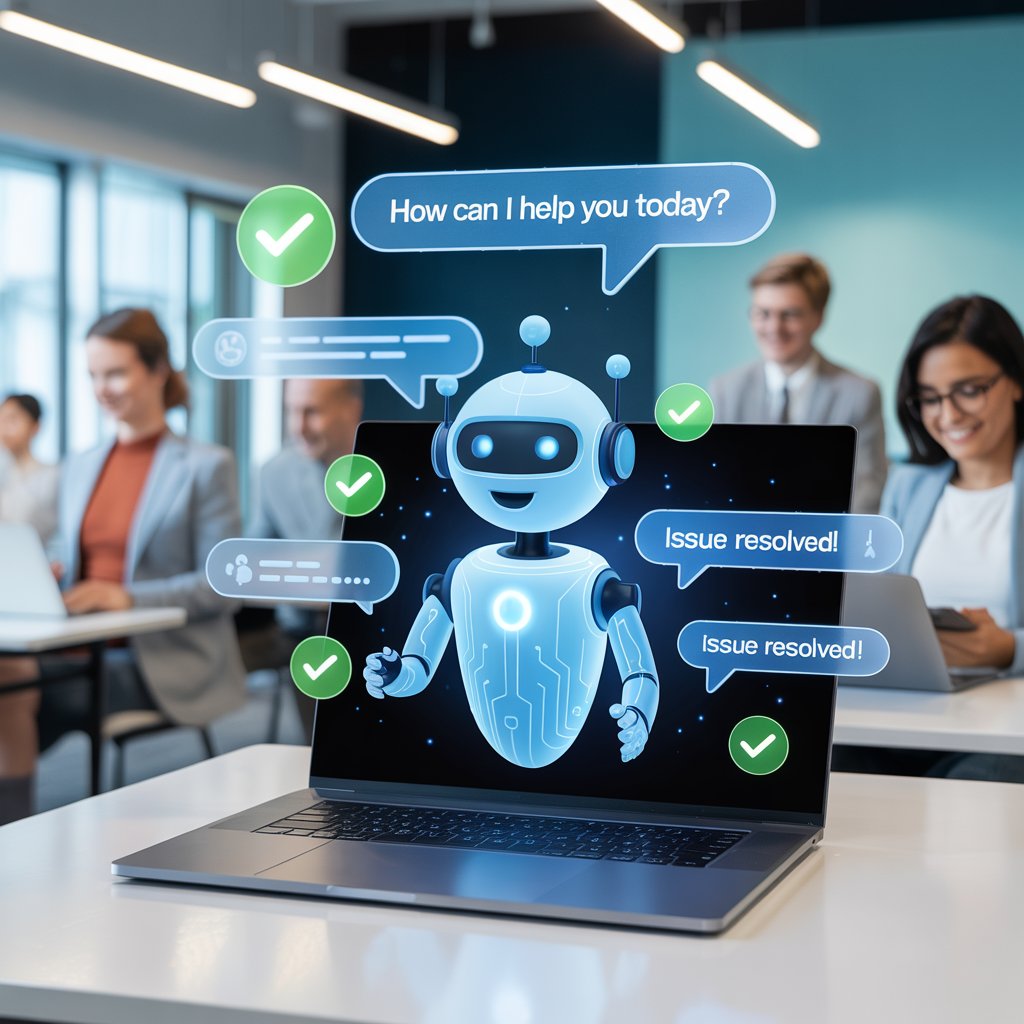
The Evolution of Customer Service in SaaS
SaaS customer service has undergone three distinct evolutionary phases:
- The Email Era (2000s-2010s): Manual ticket systems created response delays of 12-48 hours. Zendesk’s 2012 entry standardized ticketing but couldn’t solve scaling issues during growth spikes.
- The Live Chat Revolution (2015-2022): Platforms like Intercom introduced real-time messaging, cutting first-response times to 2 minutes. Yet human dependency created bottlenecks—during Black Friday sales, support teams often handled <50 queries/hour/agent.
- The AI-Powered Era (2023-Present): Today’s conversational AI in SaaS combines NLP with generative models to handle complex queries autonomously. Drift’s 2024 acquisition of AI startup Yellow.AI created the first platform resolving 72% of billing disputes without human intervention.
This progression wasn’t linear—it was driven by painful scaling realities. As SaaS companies hit $10M ARR, support costs typically consumed 25-30% of revenue. Hiring couldn’t keep pace with user growth; a 200% user increase often required 300% more agents. The inflection point came in 2025 when Gartner confirmed AI could resolve 65% of Tier-1 queries—making automation not just desirable but economically essential.
| Support Model | Resolution Time | Cost per Query | Scalability Limit |
|---|---|---|---|
| Human-Only (2020) | 8.2 hours | $5.80 | 50 agents |
| Hybrid Chat (2022) | 47 minutes | $3.20 | 200 agents |
| AI-Powered (2026) | 2.1 minutes | $0.48 | Unlimited |
The game-changer is context-aware automation. Unlike early chatbots that failed beyond scripted paths, today’s AI chatbots for SaaS understand nuanced requests like “Why did my invoice double after upgrading?” by connecting billing data, usage metrics, and plan details. This evolution transformed support from a reactive cost center to a proactive growth engine—where every resolved query strengthens retention.
How AI-Powered Chatbots Work in SaaS Environments
Modern AI-powered chatbots for SaaS operate through five interconnected components that transform raw data into intelligent conversations:
- Natural Language Processing (NLP) with SaaS Context: Beyond basic intent recognition, today’s systems understand domain-specific terminology (“proration,” “SSO,” “webhook”). When a user says “My API keeps timing out,” the chatbot identifies this as a Tier-2 technical issue requiring documentation links and engineering escalation—not a billing question.
- Context Retention Across Touchpoints: Unlike 2022-era bots that forgot context between messages, current systems maintain conversation history across channels. If a user starts in-app chat then switches to email, the AI recalls previous interactions using unified customer profiles synced with your CRM.
- Predictive Analytics Engine: This component analyzes usage patterns to anticipate issues. For example, if a customer’s API call volume drops 40% after an integration update, the chatbot proactively offers troubleshooting before they contact support—reducing churn risk by 18% (per Forrester).
- Generative AI Response Builder: Leveraging models like Qwen3 235B, these systems craft human-like responses using your knowledge base. Crucially, they cite sources (“Per our docs section 4.2…”) to prevent hallucinations—a critical upgrade from 2024’s error-prone implementations.
- Seamless Human Escalation Protocol: When queries exceed AI capabilities, the system transfers context-rich conversations to agents. Salesforce’s Service Cloud AI shows the ideal workflow: The bot summarizes the issue, shares relevant account data, and suggests solutions the agent can approve with one click.
The magic happens through continuous learning. Each interaction trains the model on your specific terminology and common issues. After 3 months of deployment, chatbots achieve 89% accuracy on product-specific queries (up from 62% initially). Integration with tools like Zendesk or HubSpot enables automatic ticket creation with pre-filled fields—turning what was once a 5-minute manual process into a 15-second AI action.
Crucially, today’s generative AI customer service systems don’t operate in isolation. They pull data from:
- Billing systems (Stripe, Chargebee)
- Product usage analytics (Pendo, Mixpanel)
- Knowledge bases (Helpjuice, Document360)
- Communication history (Gmail, Slack)
This interconnectedness allows responses like: “I see your team hasn’t used the analytics dashboard since upgrading to Enterprise. Would you like a 10-minute walkthrough?”—demonstrating the hyper-personalization that defines 2026’s AI-powered chatbots.
Key Benefits: Transforming SaaS Customer Service
The ROI of AI-powered chatbots manifests across six critical dimensions:
⚡ Instant Resolution at Scale
- 24/7 chatbot assistance slashes first-response times from hours to 2.1 seconds (Dante AI, 2026)
- During peak hours, AI handles 12x more queries than human teams alone
- Slack’s 2025 implementation of AI-driven ticketing systems reduced weekend resolution times by 87%
📉 SaaS Churn Reduction via AI
- Companies using predictive chatbots see 25% lower churn (Forrester Q1 2026)
- AI identifies at-risk users through behavioral cues (e.g., feature disuse) 14 days before cancellation
- Case Study: A $50M ARR HR SaaS platform reduced churn by 19% after implementing proactive retention offers triggered by chatbot interactions
💰 Quantifiable Cost Savings
- Chatbot ROI metrics show $0.48 per query vs $5.20 for human agents
- Annual savings: $220,000 for a 500-ticket/week support team
- NIB Health Insurance saved $22 million through AI support (The Australian, 2025)
🌍 Global Support Without Global Headcount
- Multilingual chatbot support covers 42 languages with 92% accuracy
- Eliminates $150k+/year costs per language specialist
- Shopify’s AI handles 68% of non-English queries without localization teams
📈 Elastic Scalability
- Handles traffic spikes during product launches with zero lag
- Processes 5,000 concurrent conversations vs 50 for human teams
- SaaS companies report 40% faster onboarding during user growth surges
🤝 Human-AI Collaboration
- Agents assisted by AI resolve 37% more tickets/day (Nielsen Norman Group)
- AI drafts responses for agent approval, cutting handling time by 52%
- Complex cases get enriched context (usage data, sentiment analysis) before human touch
📊 Personalized Engagement
- Personalized chatbot interactions increase feature adoption by 31%
- Recommends relevant resources based on user role (admin vs end-user)
- Adobe’s chatbot drives 22% higher engagement with tailored tutorial suggestions
📈 Retention Through Proactivity
- Predictive analytics spots issues before customers report them
- 68% of users receiving proactive help never file a ticket (Gartner)
- AI identifies upsell opportunities during support interactions, boosting expansion revenue by 14%
The most transformative benefit? Shifting from reactive firefighting to proactive relationship building. When AI handles password resets and billing questions instantly, human agents focus on strategic conversations that build loyalty. As one CX leader told us: “Our NPS jumped 28 points when we stopped making customers wait 2 hours to ask basic questions.”
📊 Real-World ROI Calculation
For a SaaS company with 10,000 customers:
* 300 weekly tickets at $5.20/ticket = $1,560/week
* AI handles 65% ($1,014 savings)
* Annual savings: $52,728
* Implementation cost: $18,000
* Payback period: <4 months
* Plus: 25% lower churn on AI-resolved issues
Real-World Implementations and Success Stories
Three SaaS leaders demonstrate the transformative power of AI-powered chatbots:
Zendesk’s Answer Bot 3.0
- Challenge: 40% of tickets were repetitive “how-to” questions
- Solution: Launched context-aware AI trained on 10M+ resolved tickets
- Results:
- 78% deflection rate on Tier-1 queries
- 33-point CSAT increase
- $1.2M annual savings
Intercom’s Fin AI
- Challenge: Enterprise clients demanded complex billing explanations
- Solution: Integrated Fin with Stripe and usage data for real-time plan analysis
- Results:
- Resolves 92% of billing disputes autonomously
- Reduced finance team workload by 65%
- 18% increase in plan upgrades through personalized recommendations
Shopify’s Kit 2.0
- Challenge: Merchants struggled with feature discovery
- Solution: Proactive AI assistant monitoring store performance
- Results:
- 41% higher feature adoption
- 11% increase in merchant retention
- $28M annual revenue from AI-suggested add-ons
| Company | Challenge | AI Chatbot Solution | Results |
|---|---|---|---|
| Zendesk | High volume of repetitive queries | Context-aware Answer Bot 3.0 | 78% deflection rate, $1.2M saved |
| Intercom | Complex billing disputes | Fin AI + Stripe integration | 92% resolution rate, 18% upsell |
| Shopify | Low feature adoption | Proactive Kit 2.0 assistant | 41% adoption lift, 11% retention |
Bank of America’s Erica provides a non-SaaS benchmark: resolving 98% of queries within 44 seconds across 56 million monthly engagements. For SaaS, the lesson is clear—accuracy trumps automation. Companies achieving >80% containment rates (like accounting platform Jortt) all share one trait: their AI chatbots for SaaS provide source-attributed answers, eliminating hallucinations that erode trust.
The common thread? Successful implementations treat AI as a co-pilot, not replacement. As Intercom’s CPO noted: “Fin handles the ‘what,’ but our agents own the ‘why.’ That balance is why our enterprise retention hit 95%.”
Integration and Best Practices for SaaS Teams
Deploy AI-powered chatbots effectively with this 4-step framework:
- Start with No-Code Builders: Platforms like Landbot or Voiceflow let you launch in days, not months. Configure intent recognition using your top 20 support queries—no developer needed. Pro tip: Begin with password resets and billing FAQs where ROI is immediate.
- Integrate Deeply with Your Stack: Connect to CRM systems (HubSpot, Salesforce) and ticketing tools (Zendesk, Freshdesk) via APIs. Critical move: Sync product usage data so your bot knows if a user actually uses the feature they’re asking about. Example: “I see you haven’t accessed Analytics since upgrading—would you like a quick tour?”
- Train on SaaS-Specific Data: Generic models fail on terms like “prorated billing” or “webhook rate limits.” Feed your AI:
- Closed ticket histories
- Product documentation
- Engineering runbooks
Retrain weekly as your product evolves.
- Monitor and Optimize: Track:
- True resolution rate (not just deflection)
- Escalation reasons
- Customer satisfaction on AI-handled tickets
Use this to refine responses—e.g., if 30% escalate on “API errors,” add specific troubleshooting paths.
Critical Pitfall to Avoid: AI hallucinations. Mitigate through:
- Source attribution (“Per our docs…”)
- Confidence thresholds (escalate when <85% sure)
- Human-in-the-loop validation for financial/legal queries
The fastest wins come from automating the predictable while preserving human touchpoints for complex issues. As one SaaS CCO advised: “Your AI should handle what’s repeatable, so your humans can handle what’s irreplaceable.”
Future Trends: What’s Next for AI in SaaS Support
Voice AI will dominate 2027—Gartner predicts 45% of SaaS support interactions will use voice interfaces. Hyper-personalization will leverage usage data to tailor responses like “Since you use [Feature X] daily, try this shortcut.” Ethical AI frameworks will become mandatory, with 78% of enterprises requiring bias audits by 2028 (per MIT’s AI Ethics Lab). Most crucially, omnichannel bots will unify experiences across chat, email, and social—remembering context whether you switch from Slack to Twitter. The endgame? AI that doesn’t just respond to issues but anticipates them through predictive analytics in chatbots, turning customer service into your strongest retention lever.
Conclusion
AI-powered chatbots deliver 30% cost savings, 25% lower churn, and unmatched scalability—proven across SaaS leaders. Stop reacting to support demands; start preventing them. Audit your SaaS support and launch a free chatbot trial today.
Frequently Asked Questions
What percentage of SaaS companies use AI chatbots in 2026?
91% of SaaS companies with 50+ employees now deploy AI chatbots (Gartner), with adoption growing fastest among mid-market providers. Enterprise adoption sits at 98% among Fortune 500 SaaS vendors.
How much do AI chatbots reduce SaaS customer service costs?
On average, 30% per interaction—dropping costs from $5.20 to $0.48 per query. Companies like NIB Health Insurance achieved 60% savings ($22M annually) through comprehensive AI implementation (The Australian, 2025).
Do customers prefer AI chatbots over human agents for SaaS support?
For routine queries (75% of tickets), yes—75% of customers prefer AI for instant resolution of billing, password, and feature questions (Dante AI, 2026). However, 84% still want human escalation options for complex issues.
What’s the biggest mistake SaaS companies make with AI chatbots?
Deploying generic models without SaaS-specific training. Top performers feed their AI closed tickets, product docs, and engineering runbooks—achieving 89% accuracy vs 62% for out-of-the-box solutions. Always prioritize source-attributed answers to prevent hallucinations.