
In the rapidly evolving landscape of digital work, finding the right tool to orchestrate your team’s efforts is no longer just a luxury—it is a critical operational necessity. As we navigate through 2026, the demands on modern teams have shifted dramatically. Remote work is standard, cross-functional collaboration is the norm, and artificial intelligence has moved from a novelty to a fundamental driver of productivity. Enter Monday.com project management, a platform that has consistently redefined how organizations track tasks, manage resources, and achieve strategic goals.
Originally launched as a simple visual spreadsheet, Monday.com has matured into a comprehensive work operating system (Work OS). It empowers teams to build custom workflows that fit their exact operational needs without requiring a single line of code. At its core, the platform’s value proposition relies on highly visual project boards, robust team collaboration software capabilities, and an intuitive interface that reduces the learning curve for new users.
However, the 2026 software landscape is fiercely competitive. With the introduction of advanced AI work platform capabilities, recent shifts in Monday.com pricing, and aggressive feature expansions from rivals, buyers must carefully evaluate whether this workflow automation tool is the right fit for their specific stack. This comprehensive guide will explore everything you need to know about this leading cloud-based project tracker, breaking down its features, costs, practical applications, and how it stacks up against the best 2026 project management software alternatives on the market today.
What Is Monday.com?
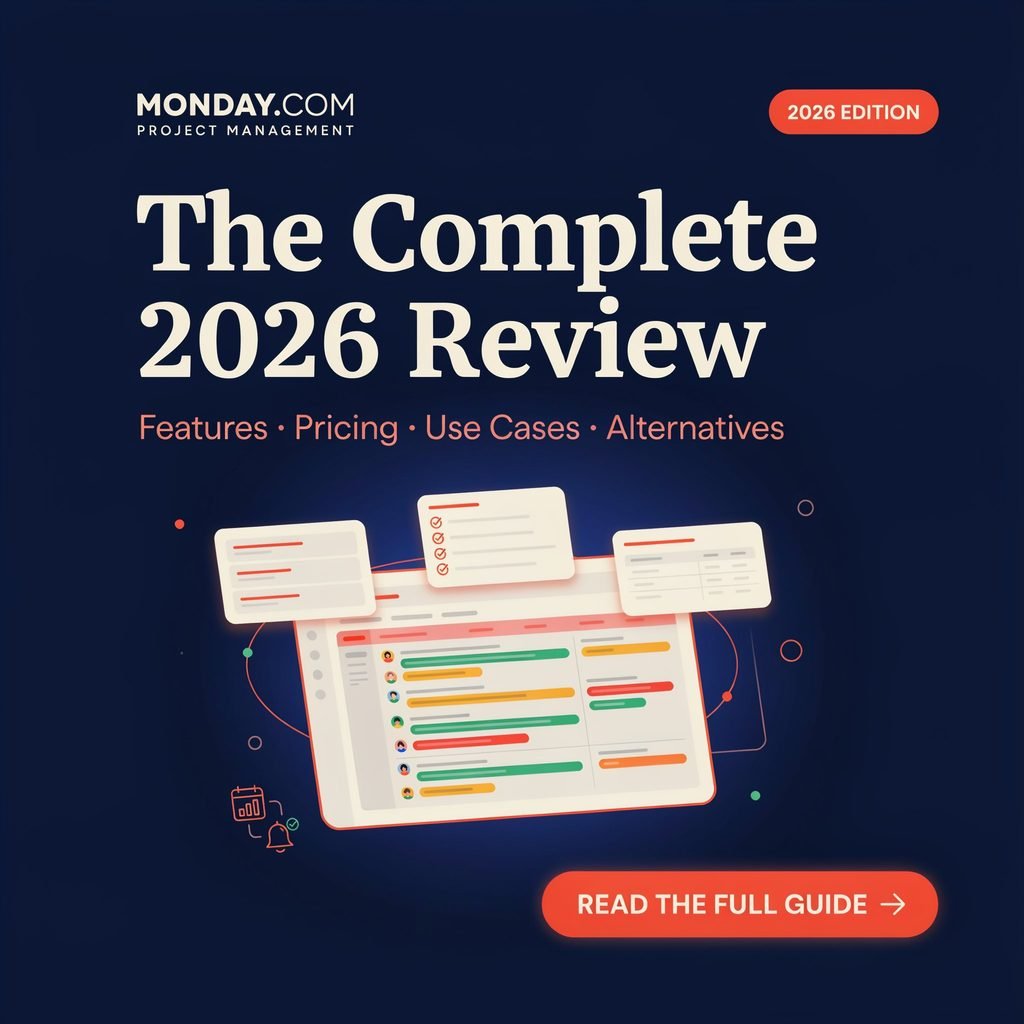
To truly understand the platform’s market dominance, we must look beyond basic task tracking. Monday.com is a highly versatile work management platform designed to connect the dots between your team’s daily tasks and your organization’s high-level objectives. Unlike legacy tools that force you into rigid, pre-defined structures, Monday.com utilizes a modular “building block” approach. Every workflow starts with a board, which is then customized using various columns (representing data types like status, dates, numbers, or people) and multiple visual views.
This flexibility is the cornerstone of its Monday.com features. Whether you are managing a complex software deployment or a simple editorial calendar, the platform’s customizable workflows adapt to your processes, rather than forcing your team to adapt to the software. This is largely enabled by its powerful no-code automation engine, which allows non-technical users to streamline repetitive tasks in just a few clicks, saving countless hours of manual data entry and follow-ups.
Furthermore, Monday.com has aggressively evolved into an AI work platform. With the integration of Monday Sidekick—their conversational AI assistant for teams—users can now generate project summaries, draft updates, and extract action items from long threads. Additionally, the introduction of Monday Vibe (their AI-driven app builder) allows teams to create code-free custom apps directly on top of their existing work data. This evolution cements its status not just as project tracking software, but as a foundational layer for building bespoke enterprise applications without relying heavily on IT departments.
Core Features of Monday.com
The true power of any Work OS lies in its feature set. Monday.com provides a vast array of capabilities designed to handle the entire lifecycle of a project, from ideation to post-mortem analysis. Let’s break down the platform’s main capabilities with practical examples.
Boards and Views
The foundation of the platform is the Monday.com boards architecture. A board acts as a centralized hub for any project, process, or dataset. However, data entry is only half the battle; how you visualize that data is what drives decision-making. Monday offers over a dozen distinct views to cater to different cognitive preferences and project types.
For agile development teams, the Kanban project tracker view is indispensable for managing sprint backlogs and tracking ticket progression from “To Do” to “Done.” Project managers overseeing complex, multi-phase initiatives rely heavily on the platform’s Gantt chart software capabilities to identify dependencies, spot bottlenecks, and adjust timelines dynamically. The timeline view offers a slightly more streamlined chronological perspective, while the calendar view ensures deadlines are never missed. For resource-heavy organizations, the workload view acts as a vital resource planning tool, preventing team burnout by visualizing capacity across assignees and calculating assigned hours against individual availability. You can even use the map view to track field sales representatives or logistics fleets using GPS data, proving the immense versatility of these visual tools.
Automation and Integrations
Manual data entry is the enemy of productivity. Monday.com combats this with its intuitive, recipe-based automation engine. Users can set up workflow automation recipes using simple “If This, Then That” logic. For example, you can create a rule stating: “When a status changes to ‘Done,’ notify the project manager and move the item to the archive group.”
But internal automation is only part of the equation. A modern workflow automation tool must play nicely with the rest of your tech stack. Monday.com boasts native integrations with hundreds of essential business tools. Seamless Slack integration allows teams to create tasks directly from chat messages, while Jira sync ensures that engineering and product teams stay aligned without duplicating data. Marketing teams benefit from deep HubSpot and Salesforce connections, while power users can leverage Zapier or Make to connect Monday to virtually any web application in existence.
Dashboards and Reporting
When managing multiple initiatives across different departments, individual boards are not enough. You need high-level visibility. Monday’s dashboard feature allows you to pull widgets from dozens of different boards into a single, unified command center.
You can build cross-board dashboards to track overall budget burn rates, aggregate time tracking across various projects, or monitor high-level KPIs. The platform’s signature “Battery Widget” provides an instant visual representation of task completion across multiple projects, while numerical overviews allow for quick financial rollups. For engineering leads, burndown charts provide real-time sprint health metrics. For executives, these dashboards serve as real-time reporting portals, eliminating the need for teams to spend hours manually compiling status reports for weekly stakeholder meetings.
AI-Powered Tools (2026 Updates)
In 2026, AI is no longer a gimmick; it is an operational requirement. Monday.com has heavily invested in this space to keep users inside the platform longer. The AI task breakdown feature can take a high-level objective and instantly generate a checklist of actionable sub-items, saving managers the tedious work of project scoping. Smart status summaries use natural language processing to digest weeks of board comments and updates into a concise, readable paragraph, saving hours of catch-up time.
The formula column assistant allows users to build complex spreadsheet-like formulas using plain English prompts, democratizing data manipulation for non-technical users. Furthermore, AI meeting notes can now integrate with your video conferencing tools, automatically transcribing discussions and assigning tasks directly to your Monday boards. Finally, predictive workload alerts analyze historical project data to warn managers if a new timeline is statistically likely to result in missed deadlines based on the team’s current velocity.
Pricing Plans and Seat Minimums
Understanding the financial commitment is crucial for any software buyer. Monday.com pricing is structured in tiers based on feature access and scale, but it has specific nuances that buyers must be aware of before pulling out their corporate credit card.
The platform offers a Free plan, but it comes with strict free plan limits: you are restricted to just two seats, a maximum of three boards, and 500MB of file storage. While this is adequate for a personal project or testing the interface, it is entirely insufficient for a functioning business team.
For growing teams, the paid tiers are where the real value lies, but they come with a catch: a paid seat minimum. You must purchase licenses in bundles of three, which can artificially inflate costs for micro-teams.
- Basic Plan ($9 per seat/month): This tier unlocks unlimited boards, 5GB of storage, and basic integrations. However, it lacks timeline and Gantt views, making it less ideal for complex project management.
- Standard Plan ($12 per seat/month): The most popular tier. It unlocks the highly sought-after Timeline and Gantt views, guest access, and a solid automation action allowance.
- Pro Plan ($19 per seat/month): Designed for scaling companies, this tier offers advanced reporting, time tracking, private boards, and significantly higher limits on automations and storage.
- Enterprise Plan (Custom Pricing): Tailored for large organizations requiring advanced security, governance, SAML SSO, audit logs, and premium support.
Buyers must also be mindful of automation action allowance caps. Lower tiers restrict the number of automated actions that can run per month (e.g., 250 actions on the Standard plan), which can become a bottleneck for highly automated workflows. Additionally, AI credits—which power features like Sidekick and formula generation—are restricted on lower tiers, requiring teams to monitor their AI usage carefully. When evaluating the cost per user, it is vital to factor in these minimums and caps to understand the true project management software pricing 2026.
Use Cases and Team Fit
Because of its modular nature, Monday.com use cases span virtually every department in a modern organization. Let’s look at how different teams leverage the platform to drive efficiency.
Marketing and Creative Teams: Marketers rely heavily on the platform as a marketing campaign tracker. They use Kanban boards for content pipelines, calendar views for social media scheduling, and digital asset management columns to keep copy and design files attached directly to the relevant campaign tasks. Creative agencies also use the platform’s proofing widgets to allow clients to leave timestamped feedback directly on video and image assets.
Software Development and IT: Engineering teams utilize Monday as a sprint management board. While they may use Jira for deep code-level issue tracking, Monday serves as the high-level product roadmap and bug-triage center, keeping non-technical stakeholders in the loop without overwhelming them with commit logs. IT helpdesks also use it to track incoming support tickets and hardware provisioning.
Operations and HR: Operations managers use the platform to document Standard Operating Procedures (SOPs) via Monday Docs, manage complex client onboarding templates, and track physical inventory or IT hardware using specialized column types. HR teams use it to visualize the recruiting pipeline, tracking candidates from application to offer letter.
Sales and CRM: While not a replacement for a heavy-duty CRM like Salesforce, Monday’s native CRM product (or highly customized boards) serves as an excellent CRM pipeline for small to mid-sized sales teams to track deal stages, manage lead follow-ups, and forecast revenue based on weighted probabilities.
Who is it NOT for?
Despite its versatility, the platform is not for solo users due to the three-seat minimum on paid plans. It is also less ideal for ultra-budget-conscious startups that need a completely free tier for a large team of freelancers. If your primary need is simple to-do lists without the complexity of relational databases and dashboards, the platform might feel like overkill. However, for remote team collaboration and hybrid work tools, it remains one of the best for small teams looking to scale their operations efficiently.
Monday.com vs. Alternatives
No software evaluation is complete without looking at the competition. The market for 2026 project management software is crowded. Let’s examine how Monday.com alternatives stack up against the industry giant.
| Feature | Monday.com | ClickUp | Asana | Trello | Notion |
|---|---|---|---|---|---|
| Entry Price | $9/seat/mo (3-seat min) | Free / $7/user | $10.99/user | Free / $5/user | $10/seat |
| Best For | Visual boards, automation | Deep customization | Task + goal tracking | Simple Kanban | Docs + wikis |
| AI Features | Sidekick, workflows, summaries | AI writing, tasks | AI summaries | Limited | AI docs |
| Free Plan | 2 seats, 3 boards | Unlimited users | Up to 10 users | Unlimited users | Limited |
| Automation | Recipe-based, tier caps | Included, flexible | Included | Basic | Via integrations |
ClickUp vs Monday: The ClickUp vs Monday debate is the most common in the industry. ClickUp is often praised for its sheer density of features and aggressive pricing (often offering more on its free plan). However, ClickUp’s UI can be overwhelming and occasionally sluggish due to feature bloat. Monday.com wins on user experience, speed, and intuitive visual design, though it costs slightly more.
Asana Comparison: The Asana comparison usually comes down to philosophy. Asana excels at traditional task management, complex dependencies, and high-level goal tracking (via its Goals feature). It is highly structured and excellent for traditional project management. Monday.com is more of a database-driven Work OS, offering greater flexibility for teams that want to manage non-traditional workflows, like event planning, CRM, or inventory tracking.
Trello for Simple Projects: If your team only needs Trello for simple projects—essentially digital sticky notes on a Kanban board—Monday.com will be overkill. Trello is faster to set up for basic needs and offers a very generous free tier, but it severely lacks the deep automation, robust reporting, and complex database capabilities of Monday.
Notion for Wikis: Many teams use Notion for wikis and internal documentation. While Notion has added databases and project tracking features over the years, it remains primarily a document-first tool that requires heavy manual setup to function as a PM tool. Monday is a data-and-action-first tool. Many mature companies use both in tandem: Notion for the employee handbook and company policies, and Monday for executing and tracking the actual daily work.
When searching for the best project management software 2026, buyers must weigh the need for completely free project tools against the operational efficiency gained from premium, AI-powered PM platforms like Monday.com.
Pros and Cons
To provide a balanced Monday.com review 2026, we must weigh the platform’s strengths against its inherent limitations.
Pros:
- Highly Visual and Customizable: The visual project boards and multiple viewing options make complex data instantly digestible for all learning styles and roles.
- Strong Automation: The recipe-based automation builder is arguably the most user-friendly and visually intuitive on the market, requiring zero coding knowledge.
- AI Integration: Features like Sidekick, smart summaries, and formula generation genuinely save time on administrative overhead and project scoping.
- Guest Access: You can invite unlimited viewers and guests to specific boards without eating into your paid seat count, which is highly cost-effective for client-facing agencies and external contractors.
Cons:
- Seat Minimums: The mandatory three-seat minimum on paid tiers artificially inflates the cost for micro-teams, freelancers, or solopreneurs looking to upgrade.
- Automation Limits: Strict caps on automated actions per month can stifle teams that rely heavily on complex, multi-step workflows. Hitting an automation limits ceiling mid-month can halt operations.
- AI Restrictions: AI credit restrictions on lower-tier plans mean you might hit a paywall when trying to use the platform’s most cutting-edge, time-saving features.
- Feature Bloat for Simple Needs: The sheer number of columns, settings, and views can cause scalability issues in terms of user adoption if a team just wants a simple checklist without the overhead of a full Work OS.
Final Verdict: Is Monday.com Worth It in 2026?
So, is this platform worth it for teams? The answer is a resounding yes, provided you fit the right operational profile. Monday.com is an exceptional choice for cross-functional teams, digital marketing agencies, SaaS operators, and mid-sized businesses that require a flexible, visual Work OS to manage diverse and complex workflows. Its robust automation, beautiful UI, and powerful AI updates make it a top-tier recommendation in any project management buyer guide.
However, if you are a solo founder, a strictly budget-constrained startup, or a small team that only needs basic to-do lists, you should look elsewhere. The seat minimums and automation caps will likely cause unnecessary financial and operational friction for your specific use case.
Before making a final financial commitment, we highly recommend you try before you buy. Utilize the free tier to build a pilot workflow, test the recipe automations, and see how your team interacts with the interface. Compare it side-by-side with ClickUp or Asana to ensure it aligns with your operational DNA. If you need a powerful, scalable, and highly visual platform to drive your team’s productivity and alignment in 2026, Monday.com remains an outstanding investment for the modern enterprise.